Some exciting news to report on book three. I’ve been working with the artist on final tweaks to the cover art, and I must say that she has done a fantastic job. I can’t wait to share it with everyone. That means book three is almost ready for print, and pre-orders should begin sometime in October. Once I know all the details, I’ll share them on here. I’m hoping for some very strong sales with the launch coming right before the holiday season. Also, Seventh Star has put together a fantastic platform for getting the word out. I’m thrilled and grateful to be one of their authors.
On the other side, because Seventh Star will be re-releasing books one and two, I will cease publishing Brotherhood and Red Sky in mid-October, just before pre-orders for book three. Anyone who wants copies of those versions either to read or as collector’s items, you have about two weeks to order them. Once I stop production, I will be unable to order any more, and I only have a couple of copies of each in my possession. So those editions, especially Red Sky, will be fairly rare items.
I’m excited about the future for the series. The new covers are going to be eye-catching and have some sizzle. Seventh Star has a pretty large group of reviewers lined up to review all three books, and I’m ready to hit a few interviews to launch the releases. It’s time to fire the big guns, baby, and let her rip!
Here are some thoughts on writing fiction. These aren’t directed at any individual; they’re just my personal musings about the craft and profession.
First, I believe good writing is a craft that must be learned and cultivated over a lifetime. Sure, there are distinctive personality traits that draw a person to the profession, but more important is the time and energy that person puts into honing their voice, playing with syntax, polishing dialogue, developing descriptions, bringing characters to life, and building tension. These are the framework of a good story, and without them, a writer is much like a carpenter who can’t hammer straight or read a tape measure.
Also, there seem to be two major categories of writers: the artist and the mercenary. I don’t mean the latter as a pejorative, simply an observation of fact. Last weekend, I heard from several of my peers that they write whatever sells. Please, don’t misunderstand. I’m all for making money and don’t begrudge them pursuing it, but as an artist, I’m more interested in developing the story that’s authentic to me. If the money never follows, so be it. I write because I have to, not because of the potential for making money, and since I have to write, I choose to create what matters to me, not what happens to be hot at the moment. If the day arrives when I write about sparkly, wimpy vampires other than as a satire, that’s the day I’ve crossed over from artist to mercenary. Of course, by that point, the new hot thing will be transgender zombies with a penchant for needlepoint, or something equally absurd.
Finally for this entry, I think the artistic writer needs to be subversive to a degree. The current trend in society is a degradation of manners, etiquette, and general decency. As an artist, I reject that trend, and my act of subversion is to carry myself as a professional, treating others with respect and dignity, unless they happen to piss me off. Then, it’s both barrels. But in general, I make a conscious decision to be polite and not give in to the decline of civilized behavior. I refuse to play the “I’m cool” game that pervades the music industry and Hollywood because that’s not my nature and not my character. I also refuse to follow the crowd. I’m an independent, free-thinking person who conducts himself, most of the time, as respectful and courteous, and I tip my hat to my fellow writers, both mercenary and artist, who do likewise.
Those are my thoughts for now. I hope to write more about the craft of writing soon.
Back in the late 80’s/early 90’s, my parents opened a ceramic shop beside our home. My father and ex-brother-in-law did most of the construction of the building, and I remember vividly how excited my parents were as everything took shape and the business launched. I helped out some in those early years, mostly doing the late night work because I was a student at WSCC and worked a full-time job at Super 8. With all of my obligations, I wasn’t able to offer them much time back then.
For the first couple of years, my father also had a second business, a snack cake wholesale and delivery service. He had his own route and also several drivers who bought from him, and back then, that business was very lucrative. The ceramics shop was in the back of the building, and the cakes were in the front. I’m certain the health inspector wouldn’t have approved because of all the dust created by the ceramics, but for some reason, they never had to have an inspection that I’m aware of. In the summers, I worked full-time for dad in the cake business because I’d grown up helping in it and knew quite a bit about the operation. At 18 and 19, each summer I took over my father’s route to free him up to run each business. I ran the delivery route through the week and drove to Georgia on the weekends to pick up from our supplier. It was a lot of responsibility for a teenager, and it matured me quite a bit.
Then, I went to Memphis to pursue my bachelor’s degree. With me leaving, Dad decided to sell off the cake business to a man who had recently been laid off from his job because of a budget cutback at the state. The ceramics business was starting to take off, so at the time it seemed like a sound decision because Dad simply couldn’t juggle both businesses anymore. Not too long after the cake business was sold, however, my parents realized just how much the revenue from it had been supporting the day to day operations of the ceramics. There were a couple of very lean months that year, but they pushed through it and got the ceramics shop profitable and sustainable by the end of the year.
Then, in February of 93, I got a call early one morning from my grandmother, if memory serves. Lightning had struck the building and before the fire department could respond, the front half of the building was destroyed. Luckily, a firetruck had been nearby, and they were able to save the back half. The firefighters did an excellent job, so please no hate mail about me disrespecting their work. There are few professions I respect more than firefighting. However, the damage to the building and the equipment was immense. Two kilns, each costing $2,000+ were completely destroyed, and others needed hundreds of dollars in repairs. The building was simply unusable.
After recovering from the initial shock, my parents gathered what equipment could be salvaged and moved the operation to our family’s 150 year old barn. In that drafty, dirty, uncomfortable environment, they limped along and struggled to rebuild the building. Defying all odds and raising suspicion among everyone, including ourselves, a year to the day later, a box fell against a kiln and burned the barn to the ground in a matter of minutes. The wood was so dry and so old that it was a pile of embers before the fire department could respond. The only saving grace this time was that much of the equipment had been moved back to the original building, and it had been rebuilt enough to be usable for them.
But honestly, they never really recovered from that second fire. I came back from Memphis in 95 and worked for them quite a bit that last year or two of the business, and while they were able to survive month to month, they just couldn’t get it back to where it had gotten. It wasn’t from lack of effort, either. We all worked pretty hard to keep that business afloat, and to this day, closing it down weighs heavily on my father.
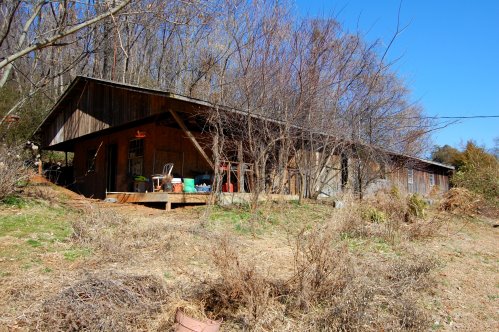
The reason why I bring this all up is because this weekend we’re probably going to sell off the molds from the ceramic shop, which are some of the last remaining relics of that endeavor. After them, all we’ll have left of the equipment will be one kiln that may or may not work and two hulls of kilns that need to be hauled to the dump. We’re getting rid of these materials to make way for the aeroponic units, and that progress is much welcomed and much needed. The farm is our future and has the potential to be as successful as we choose to make it be, but there’s a part of me that’s sad to see the old stuff go. There was a lot of sweat and energy and toil put into the ceramic business to keep it running. And love. My parents poured all of their love into it, and in some ways I feel like those molds have absorbed and still hold that love, so I’ll be a little sad when the molds are gone.
Out of respect for their efforts, I’ll work as hard as I can to make this farm successful, not only for myself but for my mother, and my father. They all deserve to see something positive and productive rise up from all of their hard work.


 Big Owl's Tree