The Writers’ Workshop Ramblings


The Writers’ Workshop of Science Fiction and Fantasy

In seeking publication for his newest workshop project, Bram Stoker award-winning editor Michael Knost sought a small press, for the care and enthusiasm a good one harbors for the genre and its fellow writers. Seventh Star Press is that kind of publisher, bringing its own love for science fiction and fantasy to the project, and its “got your back” attitude for genre writers and other small and independent presses.

Seventh Star Press is very excited about the opportunity to release this project, but as it is one outside of our originally projected 2012 publishing schedule, a little help from outside is needed to bring this project to fruition.

Perhaps the first question that comes to your mind, if encountering us for the first time, is:  Who is Seventh Star Press?

Formed in the fall of 2008, Seventh Star Press is a respected speculative fiction publisher based in Lexington, KY, boasting works from such authors as Jackie Gamber, Michael West, D.A. Adams, Steven Shrewsbury, David Blalock, R.J. Sullivan, J.L. Mulvihill, and Stephen Zimmer.  The press also features two highly-acclaimed, award-winning artists, Matthew Perry and Bonnie Wasson, whose creative work is featured on the covers and interiors of all SSP releases.

Now that you have a little more of an idea about us, we would like to introduce you to the particulars of this proposed book project.

The Writers’ Workshop of Science Fiction and Fantasy is a collection of essays and interviews with some of most influential names in the industry; each article covering a specific element of the craft of writing science fiction and fantasy.  The collaborators in this wonderful anthology include:

Neil Gaiman — “Where Do You Get Your Ideas?”

Orson Scott Card — “On Rhetoric and Style.”

Lou Anders — “Nebulous Matters, or Speculations on Subgenre.”

Lucy Snyder — “Ursula K. LeGuin Talks About A Lifetime in the Craft.”

James Gunn — “Beginnings.”

George Zebrowski — “Middles.”

Jay Lake — “Endings.”

Nayad Monroe — “Tim Powers Talks About Writing Supernatural Awe and More.”

Pam Sargent — “Talking Too Much, or Not Enough: Dialogue in Science Fiction and Fantasy.”

Geoff Fuller –– “How Alien the Alien: A Primer on Viewpoint.”

Nancy Kress — “The Green-Skinned Zorn Laughed With Grief: Character and Emotion in Science Fiction and Fantasy.”

Harry Turtledove — “Alternate History: the How-To of What Might Have Been.”

Kelly Green — “Larry Niven Talks About the Collaborative Process.”

Joe Haldeman — “Hemingway Talks About Writing.”

Nisi Shawl — “Unbending Gender.”

Alan Dean Foster — “Reverse Engineering: Writing Novelizations.”

Alethea Kontis — “Kevin J. Anderson Talks About Spin-off Novels and Prequels.”

Elizabeth Bear –– “Tactics of Worldbuilding.”

Jackie Gamber–“Ann and Jeff Vandermeer Talk About Weird Fiction”

Michael Knost — Short fiction editors Ellen Datlow, Stanley Schmidt, Gordon Van Gelder, James Patrick Kelly, Mike Resnick, and John Joseph Adams discuss what they are looking for when reading submissions.

Levels of Participation

There are seven levels of participation, six of which involve receiving a version of the book, ranging from the eBook to a limited hardcover edition.  We invite you to look over the various levels and rewards in this campaign, the core of which serve effectively as a pre-order offer for The Writers’ Workshop of Science Fiction and Fantasy.

What does the money raised in this campaign go towards?

The money raised in this campaign goes towards paying pro-rates for collaborators, as well as cover art fees and other hard costs involved in producing this title.  It will be issued in a limited hardcover edition, softcover, and various eBook formats.

How You Can Help Further

We encourage tweeting, posting, sharing, and we happily do interviews too!

You can join with us in bringing writers a wealth of insight and writing advice in a book that is rich in premium content.  Take a look at the seven options we have for this campaign and come aboard today!

Monday Morning Ramblings


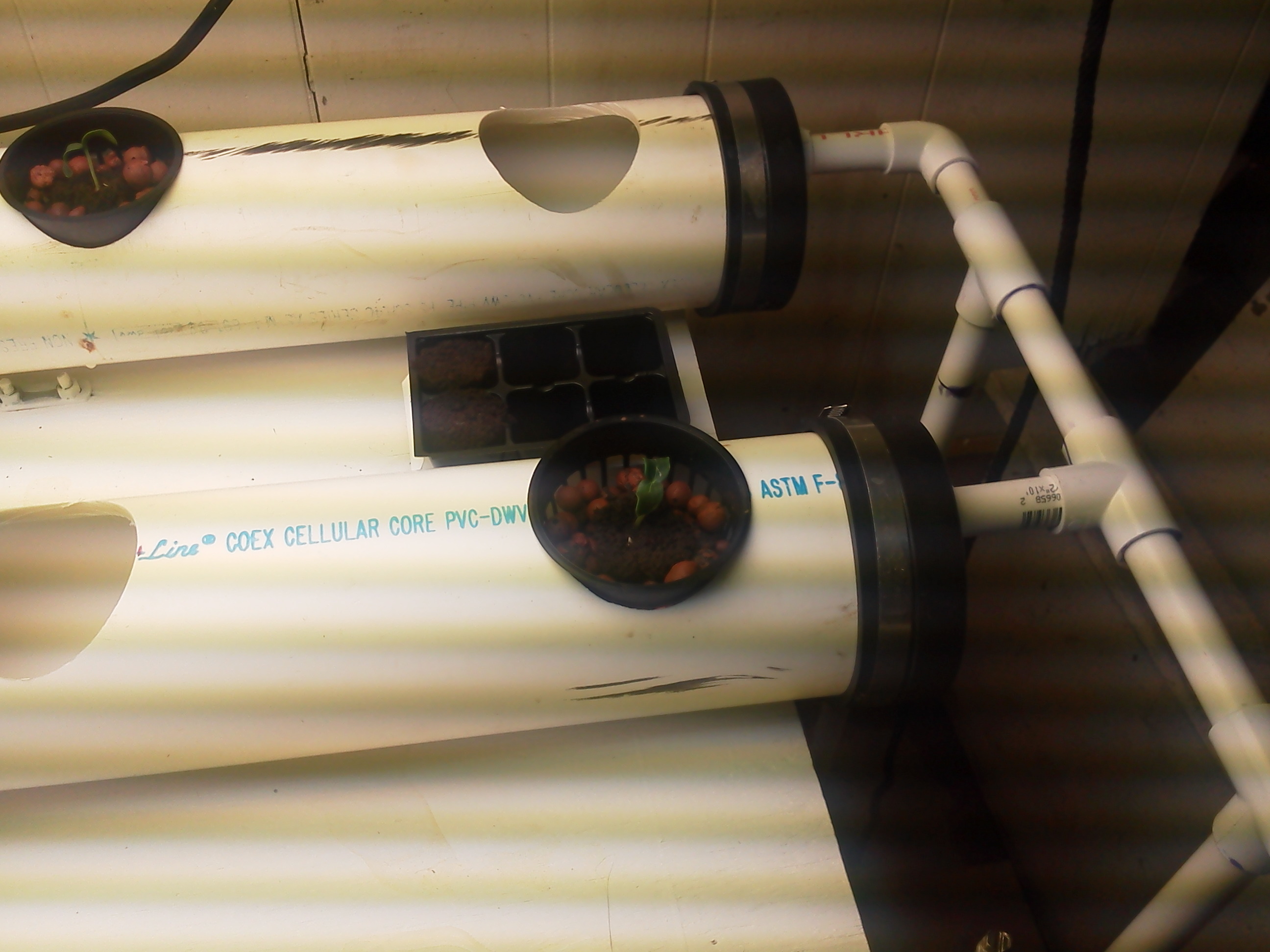
Here’s a farm update.  After two years of research, planning, testing, set-backs, building, and rebuilding, our first hydroponic system is up and running.  For the trial run, we’re growing three varieties of tomato, two kinds of lettuce, cucumbers, and cauliflower.  So far, the seedlings for spinach and peppers haven’t sprouted, though one of spinach plants looked promising this morning.  Right now, the young plants are growing well and all is working as it should.  Hopefully, in the next couple of months, we’ll have our first harvest of fresh, organic veggies, just as prices begin to skyrocket.

The thing I love about this system is the simplicity.  It’s an easily repeatable design and functions quite nicely.  We won’t know if it fully works until we get a harvest, but so far, the lights seem to produce ample spectrum; the grow chamber floods and drains the way it should; and the plants have shot up quite a bit in one week.  After watching them flourish so quickly, I’m more convinced than ever that indoor growing is the future of farming, especially as weather patterns become more and more erratic and more and more extreme.  The indoor environment is more stable, more efficient, and more controllable than outdoors.  Long-term, indoor production will be the solution to farming.

I’ll continue to post updates as the plants mature.

Thursday Morning Ramblings


I want to believe in the American Dream.  I want to believe in the United States as the land of opportunity.  However, throughout my nearly 40 years in this country, I’ve seen little proof that these notions still remain relevant for the majority of our citizens.  There are exceptions, of course.  Professional athletes still have rags to riches stories.  So do pop musicians.  And drug dealers.  Outside of those three sectors of the economy, I see few opportunities for people like me, ordinary folk not born of wealth and privilege, to break through the ever solidifying socioeconomic class system in our society.  I see virtually no upward mobility anymore, but ample downward cascading.

At the birth of our nation, two differing views of democracy vied for power.  On one side, the Hamiltonians believed that only landed gentry should have the right to vote and hold elected office.  Their rationale was that the working classes were too uncivilized and barbaric to self-govern.  They needed a strong ruling class to make decisions for them and keep them productive members of society.  If left to their own faculties, the Hamiltonians argued, the working classes would drink away their salaries, squander their resources, and create a shiftless nation of non-productive derelicts.  One can argue that there is some wisdom to this notion, for we all know plenty of people today who fit quite nicely into this vision of America the Hamiltonians feared.

Fortunately for most of us, however, there was another vision, fostered by Thomas Jefferson.  He and his followers believed that if we as a country cultivated leadership from every sector of society, providing education and opportunity for any ambitious enough to strive to better themselves, then our fledgling democratic-republic would break free from the old, feudalistic systems of Europe and create a new kind of society.  In this society, individual citizens from all backgrounds would have the right to self-govern, and furthermore, these citizens would be given the tools through public education to make better decisions for themselves and their families.  At the time, this notion was so new and so radical that even those it purported to elevate from second-class citizenship often derided it as the stuff of fairy tales.

When Jefferson was elected as our third president, his vision became the direction in which our country moved.  Throughout our history, however, this battle between the Hamiltonians and Jeffersonians has continued.  It has changed and morphed and evolved over the last 200+ years, but at its core, the central debate has remained the same.  Some believe that we need a wealthy elite to rule and lead, and others believe that even “commoners” have the ability to self-govern if given the proper tools.  There are countless shades of gray between these two poles, with countless visions and variations on how to arrive at each end.

Today, it feels as if the Hamiltonians have won.  Both of our major political parties seem to believe that the average person is incapable of self-governance.  Throughout my lifetime, self-sufficiency has been attacked and eroded from each end of the spectrum.  Now, the debate seems to be more about who should control the masses, big government or big business.  In my experience, neither has proven to have my best interests at heart.  In America today, I feel disenfranchised, powerless, and at the mercy of those in charge, which goes against everything I was taught about the foundation of our Constitution.  In this upcoming election, neither candidate puts forth a vision of America that I believe in, and the election itself seems more like a circus sideshow than a real public discourse on the direction of our society.

I want my country back.  I want a nation in which I feel in charge of my own destiny.  I want the opportunity to ply my trades without overbearing regulations from the government and competition squelching nonsense from the corporations.  I want a country that embraces innovation and technology again.  I want a country that allows for religious freedom for all.  I want a country in which a person can sink or swim based on their abilities and persistence, not on how much money they have to throw at a problem.  I want a country that embraces education and free thought and encourages individual expression.  I want the America I was promised as a child.

The adventure you've been waiting for!