
All posts by D.A. Adams

D.A. Adams is the author of the Brotherhood of Dwarves series and the Sam Skeen saga. He received a Master of Arts in Writing from the University of Memphis in 1999 and taught college English for 16 years. He is the father to two amazing sons and resides in East Tennessee.

Late Night Nonsense

DSC_0968mc
My career in education is over. I’ve waited a week and a half to write this entry because I wanted to sift through my emotions first, but now, sitting here alone after midnight and sorting through nearly two decades worth of stuff, I’m still not sure what my emotions are. I know I feel as if I’ve wasted my life and my talents. I feel undervalued, under-appreciated, and under-rewarded for sixteen years of service. I feel trapped by poverty, by a broken body, by a crushed spirit. I feel like my society tricked me into believing one set of values — that hard work, education, and dedication mattered — only to bury me in student loan debt without any means of repaying it because those values in this country today are nothing more than empty platitudes. Right or wrong, that’s how I feel.

I want to write a lot more, but I don’t want to say anything else. I’m going to finish the final book in the Brotherhood series, and from there, I have no idea where my life will go. Somehow, someway I have to find a way to earn enough money to do more than simply survive. My body is too tired, too fragile, and too damaged for survival. On a side note, to the jackasses out there who pirate copies of my books, you’re stealing from a man who can barely keep his lights on month to month. Thanks. I truly hope there is a special room in hell for people like you.

I’m sorry to whine, but there’s little left in my tank. I feel completely and utterly spent in every conceivable way. Hopefully, now that the stress and grind of education are behind me, I will begin to recover somewhat, but right now at this moment, I feel physically and emotionally broken. In the past, I’ve always been able to push through every sort of physical discomfort life has thrown at me, but for some reason, this is different. I don’t know if the neurological stuff has worsened and weakened me or if I’m simply getting older and softer or if I’m just exhausted, but right now, I can’t push through whatever this is.

That’s all for now. Sorry to be such a downer.
The Ramblings of D.A. Adams

Cover-2
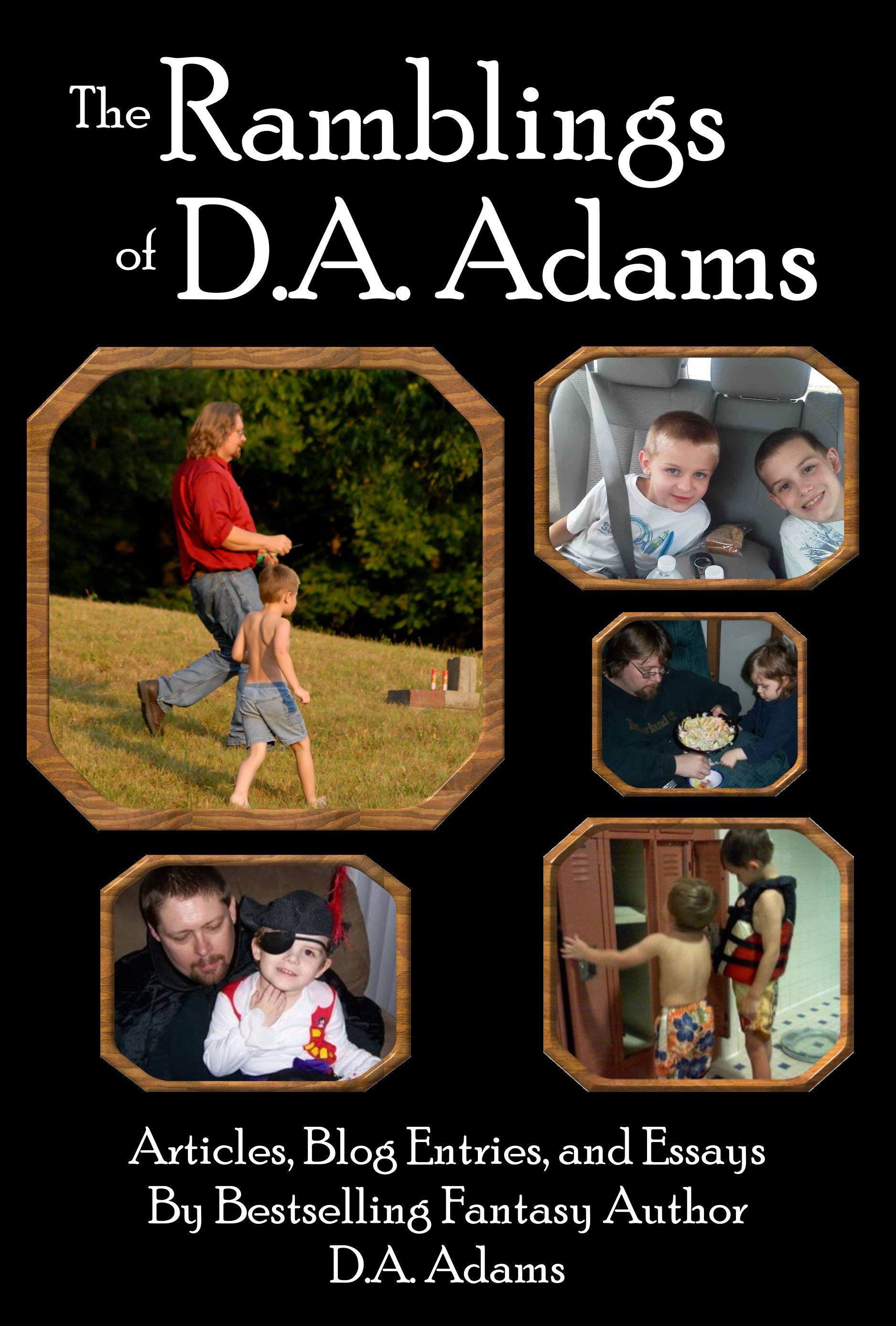
I’ve got a new release out, The Ramblings of D.A. Adams. Some of you will recognize that as the former name of my blog. This release is a collection of some of my favorite entries over the years, along with a few articles I’ve put together, and is available exclusively in ebook format. Please, go grab a copy so I can afford to get some work done to my awful teeth…

Pause, Stop, or Half-Stop

DSC_0968mc
For several years now, I’ve seen multiple authors who compose writing “advice” pieces share something that disturbs me. The first time I saw it, which was about fifteen years ago, I shrugged it off as the musings of an incompetent hack, but now, as I’ve seen it several times in several places, I’m concerned that it’s indicative of a deeper erosion in the fundamentals of our language. This advice has to do with the use of the semicolon. Actually, to be more accurate, the writers advise not to use it, ever, because it’s a meaningless symbol. The writer and teacher in me bristle at the notion that a piece of punctuation is useless just because they themselves don’t know how to use it.

I don’t want to spend this whole entry on the proper uses of the semicolon because that would be pretty boring, but I feel like a basic explanation is necessary. The period represents a full stop. I’ve ended this thought and am moving on to another one. The comma represents a pause during the course of a thought, perhaps to distinguish between a group of three or more, to set off an appositive, or to illustrate a transitional clause. The semicolon is used when the writer doesn’t quite want a full stop; the two thoughts are somehow connected. It can also be used to separate a complex series such as when the writer needs to describe a place and a character; show deep, intricate emotions; or illustrate multiple actions occurring simultaneously. These uses of the semicolon are relatively simple but are important for conveying subtlety or precision of thought.

It baffles me that anyone would advise not using a tool in the chest, especially one that can offer so much flexibility in the expression of thought. I can’t imagine a master carpenter telling an apprentice not to learn how to use a reciprocating saw because they already know how to use a skill saw. Both tools are important for achieving different kinds of cuts, and knowing how to use each one allows the carpenter to do more on the job site. The semicolon is just a punctuation tool and a relatively simple one at that, so to me, the lack of understanding of how to use it points to a larger issue in our culture: a decline in subtlety of thought and nuance.

Maybe I’m reading too much into it. It could just be that the particular people who’ve offered this advice are crappy writers with delusions of grandeur. I don’t know. What I do know is that the semicolon isn’t that difficult a piece of punctuation to master, so to any young writers who stumble across this entry, please, learn how to use the tools of your trade, as many of them as you can. Otherwise, you’re just a jackleg carpenter who can’t properly build a house.