
All posts by D.A. Adams

D.A. Adams is the author of the Brotherhood of Dwarves series and the Sam Skeen saga. He received a Master of Arts in Writing from the University of Memphis in 1999 and taught college English for 16 years. He is the father to two amazing sons and resides in East Tennessee.

Wednesday Night Ramblings – 2/15/17

TheProfessor

An aspiring writer asked me to share my process for outlining. First, let me say that there’s no one right way to outline. If you find a process that works for you, follow it as long as it feeds your creativity. The process I’ll describe is mine and works for me, but it might not be the best fit for you. So please keep in mind that anything that doesn’t help should be discarded. Only hold onto the pieces that allow your writing to flow. Also, this is my process for outlining a novel, and there are different processes for other types of writing.

My first step is to figure out the beginning and the ending of the book. I need to have a rough idea of those two before I can do anything else. Typically, I’ll sketch out a few notes about each, but for the most part, the details are just in my head. One thing to keep in mind here, however, is that the ending I envision beforehand may not be the final form. In fact, there are almost always changes and alterations as the story comes into focus, but I have a general idea of where the story will stop.

From there, I sketch out each chapter individually, noting the primary scenes. I jot notes to myself on the characters involved and the basic components. These are usually in keyword form that will trigger my memory later. What I try to develop is a skeleton of the entire book so that I have a clear vision of the overall story arc before I begin writing. Much like the ending, the scenes that are developed during the outline may change through the course of the writing, especially as the characters surprise me in the flow of the action.

When I begin writing, I refer back to the outline regularly to make sure I’m staying on track with the overall story, but I also make changes to it as the story evolves. Quite often, I’ll realize that a scene belongs in a different chapter to make time line up, or I’ll scrap one altogether because it’s just not needed. Also, I may realize that a new scene is needed because some details are missing. However, by the time the book is complete, the outline and the book remain relatively consistent with each other.

So that’s my basic process. It ends up being fairly middle of the road between a rigid plotter and a seat of the pants writer, and for me, this allows me the best of both worlds. I have a good idea where I’m going and how I’m getting there, but I also have the latitude to allow the story to grow organically. Hope that this has been useful for you if you’re an aspiring writer, and for the rest of you, I hope this has been an entertaining insight into the mind of a writer.

Monday Night Ramblings – 2/13/17

d-a-motivational-monday-2_12

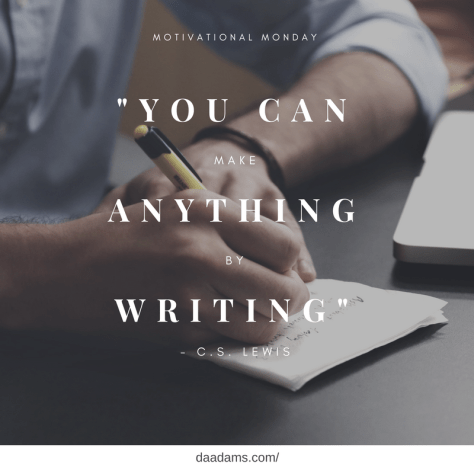
For this week’s Motivational Monday post, we have this quote from C.S. Lewis, “You can make anything by writing.” While this quote is geared towards writers, I would like to apply it to everyone. Each of us is the architect of our future, and each of us has the power to design tomorrow as we see fit. I know I am guilty too often of limiting myself because of fears or insecurities, and I try regularly to overcome these self-imposed limitations by focusing on the goals I have set for myself and trusting that I deserve to achieve them. One of the most important steps of building a better future is to believe that you are worthy of success, prosperity, and happiness.

For many of us, that is our biggest obstacle to creating the future we desire, but if we want to rise above our current circumstances, we first have to believe that we deserve that future. From there, we can then begin building the steps to make that future ours. For those of us who are writers, those steps include not only writing the works we have in our heads but also marketing and promoting those books. If your goal is to lose weight or improve your health, those steps will include improving your diet and exercise routines. If your goal is to learn more job skills or expand your education, your first steps will be to change how you spend your free time to include studying and learning.

No matter what our goals might be, we can build the future to get there if we are willing to develop a feasible plan to get there and then stick to that plan until we reach our objectives. Creating a new life is a process, and like any other process, it requires perseverance and persistence whenever we hit the rough patches. However, we really can create any future for ourselves, just as a writer can make whatever our imaginations can conjure.

Thursday Afternoon Ramblings – 2/9/17

TheProfessor

Someone asked me recently what’s the one historical event I would like to witness. For me, the moment I would most like to experience is the birth of the printing press. In my mind, this is the most significant event in human history. Prior to this point, information was centralized in the hands of an elite minority, and populations were controlled through this lack of access to knowledge. The printing press, however, changed the balance. Suddenly, as the mode of production for written works became more efficient and less expensive, a broader spectrum of people were able to participate in the exchange of ideas. This phenomenon gave birth to the Reformation and Renaissance, which in turn gave birth to the democratic revolutions of the 18th century.

The control and dissemination of information are the most powerful forces in the world. Opinions are shaped, trends are controlled, and markets are manipulated through the flow of information. With enough propaganda and misinformation, millions of people can be convinced of any number of falsehoods. Political careers rise and fall in this manner, and with the internet, the spread of false information can take on staggering proportions. Today, we see once again the centralization of information in the hands of an elite minority (just look at how few corporations control every media outlet in the world). However, much like before in human history, diversity of voices can be the panacea for tyranny.

As a side note, there are actually two moments I would like to witness in terms of the birth of the printing press. One, of course, is the Guggenheim Press in 1439, one of the most widely known and celebrated inventions in mankind’s history. However, two hundred years before that, faced with invasion by the Mongols, Korean religious scholars invented their own printing press in order to preserve sacred texts that the Mongols had been destroying. I would love to witness both events and have an opportunity to observe the similarities and differences between the processes of each invention.